Interactive physics 互动物理 互動物理

Playground 游乐场 遊樂場

Physics you can touch: move the knobs of the universe and see what happens. 动手玩物理:转一转宇宙的旋钮,看看会发生什么。 動手玩物理:轉一轉宇宙的旋鈕,看看會發生什麼。
CMB power spectrum glider 宇宙微波背景功率谱调节器 宇宙微波背景功率譜調節器

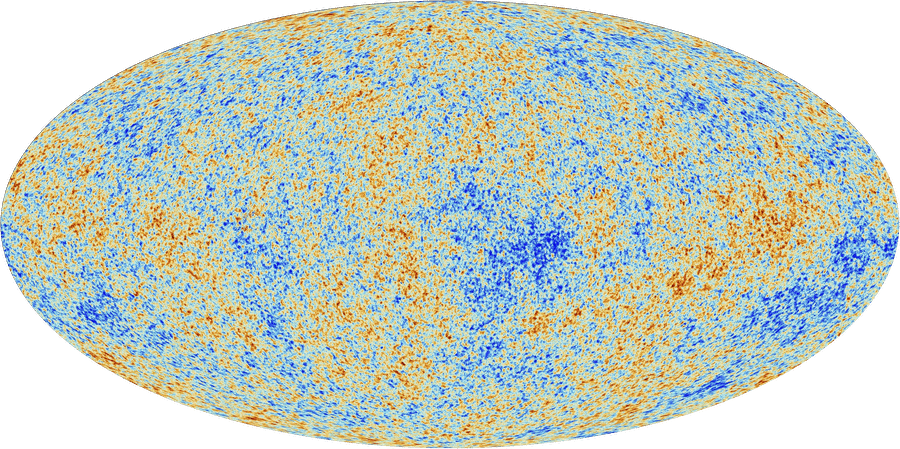
The cosmic microwave background (CMB) is the oldest light in the universe. Its tiny hot and cold spots began as quantum fluctuations in the very early universe (Planck 2018 results X). Just six numbers set their pattern (Planck 2018 results VI): move them and compare with what the Planck satellite measured. In “Find the fit” the numbers are hidden: fit the data first, then reveal the answer, much like the blind analyses cosmologists use to keep their expectations out of the result (Muir et al. 2020). 宇宙微波背景(CMB)是宇宙中最古老的光。它上面微小的冷热斑点源自极早期宇宙的量子涨落(Planck 2018 results X)。只要六个数字就能决定这些斑点的图样(Planck 2018 results VI):拖动它们,与普朗克卫星的观测数据比较。 在「找出最佳拟合」中,这六个数字会被隐藏:先拟合数据,再揭晓答案——就像宇宙学家为了不让预期影响结果而采用的盲分析(Muir et al. 2020)。 宇宙微波背景(CMB)是宇宙中最古老的光。它上面微小的冷熱斑點源自極早期宇宙的量子漲落(Planck 2018 results X)。只要六個數字就能決定這些斑點的圖樣(Planck 2018 results VI):拖動它們,與普朗克衛星的觀測數據比較。 在「找出最佳擬合」中,這六個數字會被隱藏:先擬合數據,再揭曉答案——就像宇宙學家為了不讓預期影響結果而採用的盲分析(Muir et al. 2020)。 Planck's all-sky map of the cosmic microwave background: a speckled oval of slightly hotter (orange) and colder (blue) spots The CMB sky seen by Planck. 普朗克卫星看到的宇宙微波背景。 普朗克衛星看到的宇宙微波背景。 Image: ESA and the Planck Collaboration, CC BY 4.0
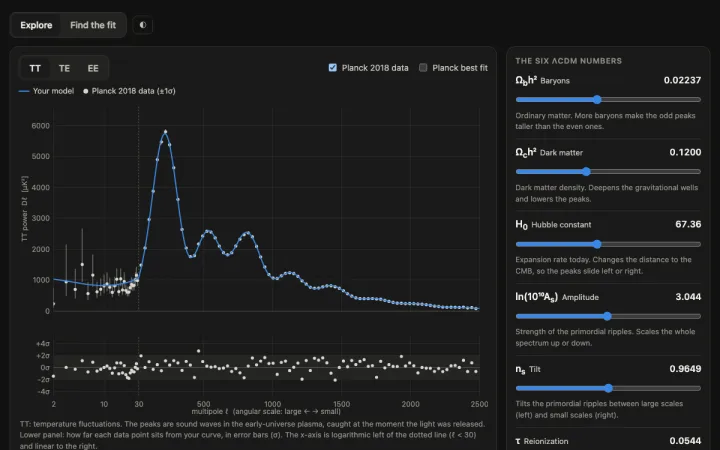
Screenshot of the CMB power spectrum glider: the TT spectrum against Planck 2018 data, beside sliders for the six ΛCDM numbers
Planck 2018 data · spectra from a neural-network emulator trained on CAMB 普朗克 2018 数据 · 功率谱由以 CAMB 训练的神经网络模拟器计算 普朗克 2018 數據 · 功率譜由以 CAMB 訓練的神經網路模擬器計算 Open full screen ↗ 全屏打开 ↗ 全螢幕開啟 ↗